
After a strong show during the September quarter (Q2FY25) and favourable demand conditions, going ahead, the country's largest player in the room air conditioner segment, Voltas is well placed to improve its market share. Expectations of record volumes in FY25 for the sector and the company's strategy of prioritising market share over margins could help the leader expand share in the room AC segment.
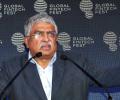
'Binary fission will happen -- startups will lead to more startups.'

After raising interest rate by a cumulative 250 basis points in 11 months, the Reserve Bank of India (RBI) on Thursday unexpectedly kept benchmark rate unchanged as global banking woes added uncertainty to the economic outlook. Five out of six members of MPC voted to remain focused on the withdrawal of accommodation to ensure inflation aligns with target while focusing on growth, RBI Governor Shaktikanta Das said on Thursday. The Monetary Policy Committee of the central bank decided to take a pause after a rate hike seen in previous six consecutive policies.

Shares of state-owned bank stocks were under pressure on Monday due to muted deposit and credit growth numbers reported by these lenders in the October-December quarter (Q3) of 2024-25 (FY25). The Nifty PSU Bank index was down 4 per cent, with Union Bank of India emerging as the biggest loser as its shares fell 7.5 per cent to close at Rs 114.7, followed by a 5.7 per cent drop in shares of Bank of Baroda (BoB) to Rs 228 and a 4.7 per cent slide in shares of Bank of India to Rs 99.8 on the National Stock Exchange.

The Indian Council of Medical Research was in talks with the Serum Institute of India for local manufacturing of monoclonal antibodies (MABs). However, it did not take off, as the volume was much less in India.

At the PMO, policies are framed by factoring in analytical perspectives, implications, sustainability, and other dimensions.

Public sector banks (PSBs) posted 16.1 per cent year-on-year (Y-o-Y) growth in net profit at Rs 39,974 crore during the June 2024 quarter. While net interest income (NII) showed subdued growth of 7.1 per cent, provisions and contingencies declined by 10.5 per cent Y-o-Y. This aided the bottom line to show steady growth.

Banking on the Budget's tax relief, the BJP seeks to energise Delhi's middle class; the AAP is doing its bit too. But will their outreach mobilise this politically crucial yet disengaged electorate?

Equity mutual funds witnessed an inflow of Rs 35,943 crore in November, marking a drop of 14 per cent on a month-on-month basis, amid heightened volatility in stock markets driven by various macroeconomic factors, geopolitical events and US election results. Despite this, it marked the 45th consecutive month of net inflows into equity-oriented funds, reflecting the growing popularity of mutual funds among investors, according to data from the Association of Mutual Funds in India (AMFI) released on Tuesday.

Tata Steel, Bajaj Finance, Mahindra & Mahindra, JSW Steel, NTPC, Adani Ports, Bajaj Finserv and Larsen & Toubro were also among the laggards. However, Power Grid, HCL Technologies, Infosys, Tech Mahindra, Tata Consultancy Services and ICICI Bank were among the gainers.

The stock of the country's largest plastic pipe maker Supreme Industries has shed 22 per cent since its highs in October. The September quarter results were below expectations as the volatility in polyvinyl chloride (PVC) resin prices led to a major destocking across the trade channel.

Gold prices slumped for the second straight session by Rs 1,150 to Rs 78,350 per 10 grams in the national capital on Monday on frantic selling by stockists and retailers, the All India Sarafa Association said. The precious metal of 99.9 per cent purity closed at Rs 79,500 per 10 grams on Friday.

'The nominal GDP growth assumption for FY25 may be revised upwards on higher growth expectations.'

The growth was primarily driven by domestic investments, which accounted for 60 per cent of the total inflows during the first quarter of the financial year.

From the 30-share blue-chip pack, Adani Ports jumped over 5 per cent. NTPC, Tata Steel, Bajaj Finserv, Zomato, Bajaj Finance, Tata Motors, State Bank of India, IndusInd Bank and Maruti were among the other big gainers. From the 30-share pack, Hindustan Unilever, Titan, Tata Consultancy Services, Infosys and UltraTech Cement were the other laggards.

Reliance has filed patents not only in India but also in the US, Canada, Europe, Estonia, South Korea, and South America. The patents include narrowband Internet of Things, AI large language models, AI DeepLearning, Big Data, devices, and quantum AI in 6G.

Of Trump's reciprocal tariffs and trade deals

Tech giant Microsoft regained the top spot in the list of best employers to work for in India in 2024, followed by Tata Consultancy Services (TCS) and Amazon, according to a Randstad Employer Brand Research report released on Wednesday. Microsoft had topped the list in 2022, but slipped to fifth in 2023. The 2024 list is based on responses from 3,507 people.

The Budget has given signals that India is sensitive to the US needs and willing to walk the extra mile, but if need be, we should respond in equal measure as a sovereign nation, notes Ajay Srivastava.

Gold prices hit a fresh record high of Rs 84,900 per 10 grams in the national capital on Friday, driven by robust domestic demand and strong global cues, according to the All India Sarafa Association. The precious metal of 99.9 per cent purity continued its ascent for the third straight session, jumping by Rs 1,100 to hit a new peak of Rs 84,900 per 10 grams.

Wedding planner WedMeGood estimates that the average wedding budget has surged to Rs 36.5 lakh this year, with destination weddings averaging Rs 51 lakh.

Most of India's oil supplies are expected to stay safe because of the country's good relations with both Russia and Iran. That would take care of over a third of India's supplies.

Well-known US activist investor Hindenburg Research has alleged that Adani Group was "engaged in a brazen stock manipulation and accounting fraud", a charge the conglomerate described as malicious, unsubstantiated, one-sided, and having done with malafide intention to ruin its share-sale. Hindenburg, a US-based investment research firm that specialises in activist short-selling, said its two-year investigation reveals that "the Rs 17.8 trillion ($218 billion) Indian conglomerate Adani Group has engaged in a brazen stock manipulation and accounting fraud scheme over the course of decades." The report comes ahead of a Rs 20,000 crore follow-on share sale of Adani Group's flagship Adani Enterprises.

Weeks after it revised the rating outlook of two companies of embattled Adani group, S&P Global Ratings on Wednesday said it is watching for additional information on the conglomerate's governance and funding for any ratings action. Investors, it said, seek clarity on the credit impact of a string of allegations against the group in a short-seller report published in late January, and on the findings of a recently launched Supreme Court investigation. S&P Global published an FAQ-style commentary titled, "Adani Group: The Known Unknowns".

RBI interest rate decision, macroeconomic data and global trends would guide markets' movement this week, analysts said. Besides, trading activity of foreign investors and the last batch of Q1 earnings announcements would also guide trends in equities. HSBC PMI (Purchasing Managers' Index) for the services sector is scheduled to be announced on Monday.

Credit card spending in September recorded strong growth of 25 per cent year-on-year (Y-o-Y), marking the highest increase in six months. Even as many banks saw higher slippages during the July-September quarter of 2024-25, spending growth exceeded 20 per cent for the first time since February. According to the latest data released by the Reserve Bank of India (RBI), September spending reached Rs 1.76 trillion, compared to Rs 1.42 trillion in the same period a year ago. In August 2024, credit card spending was Rs 1.68 trillion.
Equity markets will be driven by the outcome of the US Federal Reserve's interest rate decision this week, analysts said. Moreover, equity benchmarks will also continue to be guided by foreign fund movement and trend in Brent crude oil, they added. "The global markets are looking nervous after the US inflation numbers, which have caused the dollar index to hover around 110," said Santosh Meena, head of research, Swastika Investmart Ltd. Now everyone is eyeing the outcome of the upcoming US Federal Open Market Committee (FOMC) meeting.

'Today, let us reaffirm our commitment to strive to realise Gandhiji's dreams. His watchwords, truth and nonviolence, will continue to remain relevant for the whole world. He also taught us that rights and duties are but the two sides of the coin - indeed, the true source of rights is duty. Today we recall his lessons in compassion too - compassion not only for our human neighbours but also for our other neighbours, namely, flora and fauna, rivers and mountains.'

The stock of the country's largest passenger vehicle maker, Maruti Suzuki India (MSIL), has been hitting successive all-time highs over the past three trading sessions. The rally in the scrip has helped it notch over a 21 per cent gain since the start of February, outperforming the National Stock Exchange Nifty Auto Index. The gains for the leader of small passenger cars have been more recent, as the company still trails the Nifty Auto over one- and two-year periods.

Do we have enough trained oncologists and medical professionals in India to man these over 4,500 beds in the public sector?

The death toll climbed to 5,24,701 with nine fresh fatalities, the data updated at 8 am stated.

Presenting the Union Budget, Sitharaman announced that the government will partner with the private sector to set up Bharat Small Reactors and in the research and development of small modular reactors.

Ranveer Allahbadia found an easy way of asking questions which made sense to him and his team. No counter-questions or finding out the 'Why?' from the celebrity he was speaking to. The 'Why?' was buried and forgotten in Ranveer's shows, observes Syed Firdaus Ashraf.

Foreign investors pulled out a massive Rs 94,000 crore (around $11.2 billion) from the Indian stock market in October, making it the worst-ever month in terms of outflows, triggered by the elevated valuation of domestic equities and attractive valuations of Chinese stocks. Before this, foreign portfolio investors (FPIs) withdrew Rs 61,973 crore from equities in March 2020. The latest outflow came after a nine-month high investment of Rs 57,724 crore in September 2024.

He asserted that all efforts are on to contain the spread of the virus in Kerala.

Whether it's navigating the labyrinthine Cu Chi Tunnels, boating on the Mekong, marveling at ancient Champa temples, or the Mekong Bay, Vietnam promises a journey like no other.

From the 30-share Sensex pack, Tata Consultancy Services, Infosys, NTPC, HCL Technologies, Axis Bank, Tech Mahindra, Bajaj Finserv, Sun Pharma, IndusInd Bank and Reliance Industries were the major laggards. Tata Steel, Hindustan Unilever, Mahindra & Mahindra, Nestle and State Bank of India were among the gainers.

Researchers found that India, along with China and Japan, were the three leading countries in Asia in terms of number of new cases and deaths, where they say cancer has become a more significant public health threat with 94 lakh new cases and 56 lakh deaths in 2019.

'If you compare the data from 2017 and 2023 of the US imports from the world and China, you will see that the US was a complete loser in the trade war, and China was a complete gainer.'

Credit card spending reached Rs 2 trillion in October, a 14.5 per cent rise from September, largely driven by festival season purchases. However, the volume of outstanding credit cards increased only marginally during the same period. The spike in spending comes at a time when nearly all major credit card issuers are calibrating their growth in the segment due to visible signs of stress.
